Stretch Your Workday
Movement Microbreaks for Musculoskeletal Pain Prevention Breakthru Insights
Strain and injuries can happen to anyone and everyone in the workplace. Regardless of whether your employees work in a seat or on their feet, they are still at risk for musculoskeletal disorders, repetitive strain injuries, and discomfort.1
Approximately a quarter of all recorded occupational injuries in 2021-2022 in the U.S. involved sprains, stains, and tears.2 Overexertion and bodily reaction injuries (both direct causes of musculoskeletal disorders) was the leading cause of days away from work, days of restricted work activity, or job transfer/restriction during that same period, creating over 1 million cases.3
There is a significant cost associated. The Occupational Safety and Health Administration (OSHA) estimates non-fatal workplace injuries cost employers approximately $1 billion dollars per week in direct costs.4
Introducing a workplace stretching program is a simple, effective step your organization can take towards fostering a safer and more engaged workforce—with fewer safety incidents, reduced absenteeism, enhanced mental clarity and alertness, and lifted morale.5
Why Stretch Breaks at Work Matter
Stretching is fundamental to maintaining physical health. It improves blood flow, supports mobility and range of motion, reduces muscle tension, and prevents stiffness, making the body more resilient to movement.6,7,8
Just like how a car engine needs to warm up before driving, the body needs stretches to warm up before (and during) work. Stretching helps muscles stay flexible and healthy—supporting overall range of motion in the joints, improving balance, and helping reduce the risk of falls. Without regular stretching, our muscles become shorter and tighter, and cannot fully extend, placing us at an increased risk of joint pain, strains, and muscle damage.6,7
Beyond keeping muscles resilient and ready, stretching also engages connective tissue, including ligaments fascia. This connective tissue links muscles, bones, blood vessels, and organs, and is vital to the body systems successfully working together. Even slight injuries can cause adhesions in the fascia, which can lead to reduced mobility and activity, and worsened pain.9

Regular workplace stretching provides several key benefits.
Stretching increases flexibility and mobility, which helps employees move more freely and perform tasks with reduced risk of injury.10 This is especially beneficial for jobs that require frequent bending, reaching, and lifting.5
Stretching improves circulation, delivering more oxygen and nutrients to the brain and muscles. This helps reduce instances of muscle cramps and fatigue, and enhances mental alertness and clarity.6,7,11 Research shows the minimum time for static stretching to maintain an increase in muscle blood volume after stretching is just 2 minutes.12
Stretching reduces muscle tension and stress. Prolonged static/sedentary positions such as sitting and standing, and frequent repetitive motions place stress on the muscles. Short stretch breaks eases the strain of repetitive and awkward motions while reducing physical and mental stress.10,13
Stretching improves posture. Jobs that involve prolonged sedentary periods, bending, and lifting can worsen posture. Enhanced posture reduces the risk of back pain, neck pain, and headaches as well as reduces the strain of prolonged sitting and standing.14
Employees in physically demanding jobs can benefit from workplace stretch programs through reduced injury rates, fatigue, and musculoskeletal complaints. Stretching helps employees prepare their bodies for repetitive, strenuous tasks.10
Meanwhile, employees in sedentary roles benefit from improved posture, reduced back pain, and fewer repetitive strain injuries.10
Stretching benefits the mind as well as the body. A short stretching break can provide a mental reset, especially during long and intensive work sessions.8 Workplace stretching programs are associated with increased energy levels, improved mental alertness and clarity, enhanced team morale, and reduced absenteeism.5
But to make a workplace stretching initiative successful, leaders must take an active role. Employees often avoid stretch breaks, out of fear of appearing unprofessional, distracting others, or being less productive.15,16
When leadership participates in and supports stretching initiatives, employees are more likely to do the same.10,11 Research shows short, regular breaks improve compliance and help employees establish a stretching habit.17,18

Breakthru for Health, Safety, and Injury Prevention
Breakthru is a tool to incorporate regular stretch breaks into the flow of your team's workday.
Our system of guided, 2-minute movement breaks are designed for people of all abilities, comfort levels, for workers in all kinds of jobs, and can be configured on any device with a screen. 1 in 3 users turn to Breakthru for its positive impact on pain mitigation and injury prevention.19
Lightning Round Science
- Movement microbreaks throughout the day reduce musculoskeletal pain especially in the neck, wrists, shoulders, and lower and upper back.20
- People who take frequent short breaks experience fewer headaches, less eye strain and lower rates of back pain.21
- A work–rest schedule including 1-minute microbreaks significantly reduces muscle fatigue without affecting work productivity.22
- Those taking stretching microbreaks throughout the day report the greatest reduction in musculoskeletal discomfort compared to sedentary breaks.23
- Stretching decreases the prevalence of musculoskeletal disorders and the days missed from work as a result.5
- A greater frequency of stretching results in significantly less pain symptoms.10
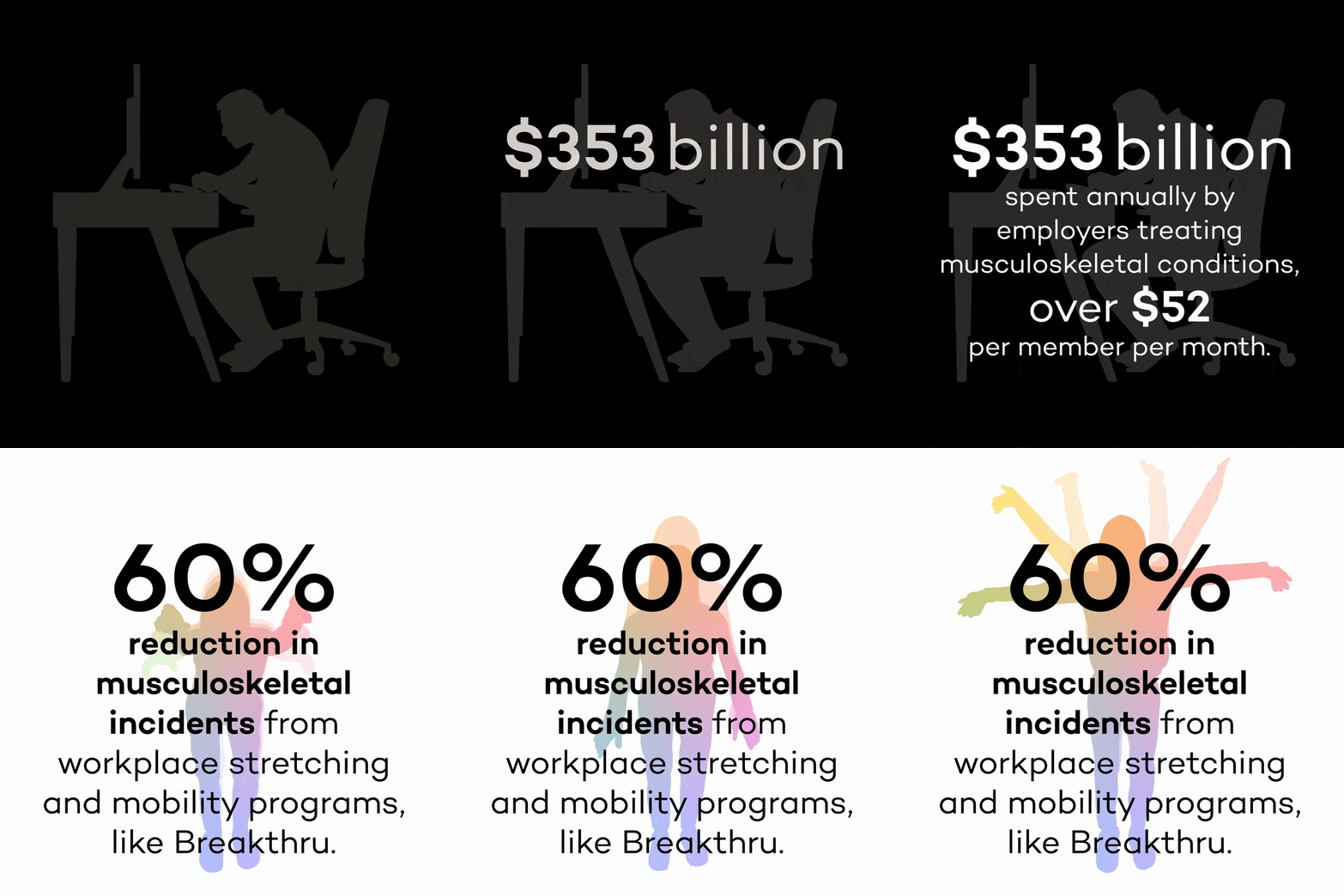
- Daily workplace stretching routines are associated with reduced injury rates and fewer musculoskeletal complaints, with a 60% reduction in musculoskeletal incidents and 50% reduction in Workers' Compensation claims from workplace stretching and mobility programs.10,24
- Greggi, C., Visconti, V. V., Albanese, M., Gasperini, B., Chiavoghilefu, A., Prezioso, C., Persechino, B., Iavicoli, S., Gasbarra, E., Riccardo Iundusi, & Tarantino, U. (2024). Work-Related Musculoskeletal Disorders: A Systematic Review and Meta-Analysis. Journal of Clinical Medicine, 13(13), 3964–3964. https://doi.org/10.3390/jcm13133964
- Sprains, Strains, and Tears: The Most Common Workplace Injuries. (2024, May 24). USClaims Financial Support | A Pre-Settlement Funding Firm. https://usclaims.com/educational-resources/sprains-strains-and-tears-the-most-common-workplace-injuries/
- National Safety Council. “Top Work-Related Injury Causes - Injury Facts.” Injury Facts, 2018, injuryfacts.nsc.org/work/work-overview/top-work-related-injury-causes/. Accessed 7 Oct. 2026.
- Occupational Safety and Health Administration. “Business Case for Safety and Health - Overview | Occupational Safety and Health Administration.” Www.Osha.Gov, www.osha.gov/businesscase. Accessed 7 Oct. 2026.
- OHSE. “The Importance of Workplace Stretching: Enhancing Health, Safety, and Productivity - OHSE.” OHSE, 24 Apr. 2025, ohse.ca/the-importance-of-workplace-stretching-enhancing-health-safety-and-productivity/. Accessed 7 Oct. 2026.
- LeWine, Howard E. MD. “The Importance of Stretching.” Harvard Health, 17 Apr. 2024, www.health.harvard.edu/healthy-aging-and-longevity/the-importance-of-stretching. Accessed 7 Oct. 2026.
- Harvard Health Publishing. (2019). The ideal stretching routine - Harvard Health. Harvard Health; Harvard Health. https://www.health.harvard.edu/staying-healthy/the-ideal-stretching-routine
- Konrad, Andreas, et al. “The Effects of Chronic Stretch Training on Musculoskeletal Pain.” European Journal of Applied Physiology, vol. 125, no. 8, 9 Mar. 2025, pp. 2037–2048, 10.1007/s00421-025-05747-9.
- Langevin, Helene. “Making the Case for More Stretching, Less Stressing.” Nccih, 5 May 2020, www.nccih.nih.gov/research/blog/more-stretching-less-stressing. Accessed 7 Oct. 2026.
- Gabat, Qais, et al. “Impact of Stretching Exercises on Work-Related Musculoskeletal Disorders: A Systematic Review.” ResearchGate, Australian International Academic Centre, 31 July 2023, www.researchgate.net/publication/375763279_Impact_of_Stretching_Exercises_on_Work-Related_Musculoskeletal_Disorders_A_Systematic_Review. Accessed 7 Oct. 2026.
- Harvard Health Publishing. “Leg Stretching May Improve Blood Flow and Prevent Strokes - Harvard Health.” Harvard Health, Oct. 2020, www.health.harvard.edu/healthy-aging-and-longevity/leg-stretching-may-improve-blood-flow-and-prevent-strokes.
- Matsuo H., Kubota M., Shimada S., et al. The effect of static stretching duration on muscle blood volume and oxygenation. The Journal of Strength and Conditioning Research . 2022;36(2):379–385. doi: 10.1519/jsc.0000000000003457.
- Freyer, Marion, et al. “Evaluating the Methods Used to Examine Sitting Breaks and Their Influence on Mental Load, Physical Strain, and Cognitive Performance - a Scoping Review.” Frontiers in Physiology, vol. 17, 18 Feb. 2026, pmc.ncbi.nlm.nih.gov/articles/PMC12956524/, 10.3389/fphys.2026.1755356. Accessed 7 Oct. 2026.
- Ding, Yi, et al. “It Is Time to Have Rest: How Do Break Types Affect Muscular Activity and Perceived Discomfort During Prolonged Sitting Work.” Safety and Health at Work, vol. 11, no. 2, June 2020, pp. 207–214, 10.1016/j.shaw.2020.03.008.
- Schabram, Kira, and Christopher M. Barnes. “A Guide to Taking Better Breaks at Work.” Harvard Business Review, 4 Feb. 2025, hbr.org/2025/02/a-guide-to-taking-better-breaks-at-work. Accessed 7 Oct. 2026.
- Phan, V., & Beck, J. W. (2023). Why do people (not) take breaks? An investigation of individuals’ reasons for taking and for not taking breaks at work. Journal of Business and Psychology, 38(2), 259–282. https://doi.org/10.1007/s10869-022-09866-4
- Diesbourg, Tara L., and Kathryn M. Rougeau. “Stretching Programs in Manufacturing: Lessons Learned From Implementation.” Prof. Safety, vol. 70, no. 09, 1 Sept. 2025, pp. 22–32, onepetro.org/PS/article-abstract/70/09/22/789515/Stretching-Programs-in-Manufacturing-Lessons. Accessed 7 Oct. 2026.
- Nie, Q., Zhang, J., Peng, J., & Chen, X. (2023). Daily micro-break activities and workplace well-being: A recovery perspective. Current Psychology, 42(12), 9972–9985. https://doi.org/10.1007/s12144-021-02300-7
- 2026 corporate study of 500 employees
- Grünwald, J. A., & Licka, T. F. (2023). Health Promotion for Students of Veterinary Medicine: A Preliminary Study on Active Microbreaks and Ergonomics Education. Animals (2076-2615), 13(10), 1641. https://doi.org/10.3390/ani13101641
- Emily Hunter, first author of the study and an associate professor of management at Baylor’s Hankamer School of Business” (Heid, 2018, p. 1).
- Beltran Martinez, K., Nazarahari, M., & Rouhani, H. (2023). Breaking the Fatigue Cycle: Investigating the Effect of Work-Rest Schedules on Muscle Fatigue in Material Handling Jobs. Sensors, 23(24), 9670. https://doi.org/10.3390/s23249670
- McLean, L., Tingley, M., Scott, R. N., & Rickards, J. (2001). Computer terminal work and the benefit of microbreaks. Applied Ergonomics, 32(3), 225-237. https://doi.org/10.1016/S0003-6870(00)00071-5
- Wolff, Ryan. “Efficacy of a Stretch and Flex Program.” ResearchGate, unknown, 16 May 2021, www.researchgate.net/publication/364476919_Efficacy_of_a_Stretch_and_Flex_Program. Accessed 7 Oct. 2026.
Breakthru in the World
Request a demo to learn how teams stay sharper, healthier, and more connected with Breakthru
See how science-backed, 2-minute microbreaks can boost focus, motivation, and resilience for your organization.
Join the
45,000+
corporations, educational
communities, and non-profits
worldwide using Breakthru.