Find Your Best Form: A Conversation with Katerina Stefanidi
Note: This conversation has been edited for length and clarity
What do you think about people discovering movement, and how much censorship goes on around it, both in the day and in sport?
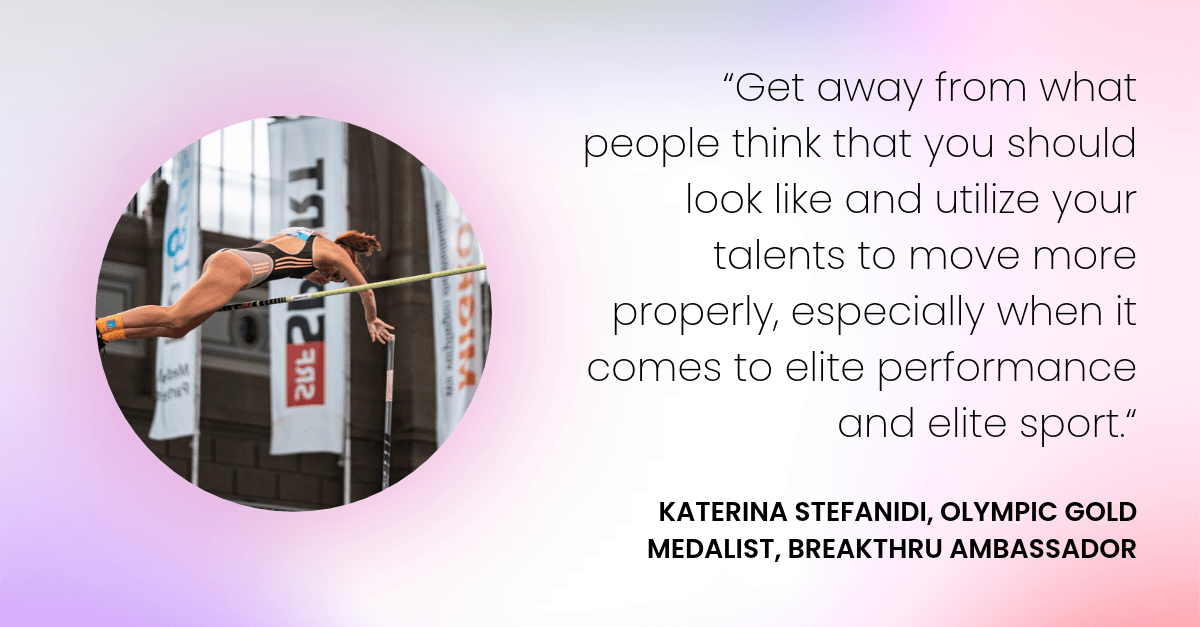
10 years ago, if you asked me this question, the answer would be completely different. We used to think pole vault is one model, one way, and how close to that model can you physically get? But in the last 10 years, professional sport has taught us the exact opposite. Everybody has different talents and obviously, physics is physics, right? And that's what you're trying to beat in pole vault. But people have been so successful in so many different ways—many times opposite of what we've been trying to teach. With every year, I feel like we go further away from this idea of one or two correct models, more to everybody's an individual. We all move differently. We all have different talents
We've seen it with kids that come to us after they have already been coached. It almost seems like the athleticism has been taken out of them, trying to fit a certain model and look a certain way. Right now we have this super talented boy that has been to a lot of track clubs that have tried to teach him to sprint correctly. Now, he looks so exaggerated and almost robotic that we're now trying to undo what he's been told so that he finds the correct way to sprint for himself, not just what people think he should look like.
Our coaching uses less specific cues and more like ‘connect to the ground’, ‘make it smoother’, ‘make it more fluid.’ I do wonder sometimes if they feel like we're under-coaching them because it sounds like we're telling them these very vague things. But there is purpose in us saying this. We want to see what they do to achieve connecting with the ground or being more fluid, to then potentially give them a slightly more specific cue. Really, find your own best form is what we're trying to teach them.
My husband grew up playing baseball, and he always remembers that they were told not to watch the professionals play because they do it wrong. But maybe the best people in the world do it wrong because they do it their own way and have figured out the best way for themselves.
As adults we can feel like we're not good athletes or we're not good movers, and it can be very much based on what somebody told us when we were younger. For me 100%, I feel like I'm not a good dancer—and I’m probably not a good dancer—but I think I feel that way because that’s what I was told growing up versus I was always told I was a very good athlete. I have zero confidence in my dancing abilities, and I have high confidence in my athletic abilities. So 100% I believe that censorship of movement starts very young.
Do you have any childhood memories of moving to learn, where your body taught you something that you couldn't have learned any other way?
I started pole vault when I was 10 and I went into a system that was very much the opposite of what I'm describing now. I had to look a certain way. I had to do things a certain way. I was a very good pole vaulter from a very young age, it was clear, but I was very bad at fitting that model. I was always fighting that idea, and I felt like I was losing energy in my jump that way. Maybe my body was already trying to teach me that you shouldn't follow a model. There's not one right way, even though I was constantly being told the opposite.
That feeling of being aligned with the physics of it, can you describe that?
For me, pole vaulting, and really even sprinting—which are the two main things we do—when you do it right (and again, right is slightly different for everyone), it feels effortless.
A lot of the kids that come to us think that the hard part of pole vault is what happens in the air. The truth is, once you're in the air, there's not much you can do anymore. It's all about the energy that you put into the jump, that's what you're going to get out of it. When you take a good jump, once you're in the air, it feels like you're doing nothing. It should feel fluid. It should feel effortless. When you do it at your best, it feels like you're not really trying.
How does that equate in your life to things that are not movement related?
I think with creativity. Even just at different times of the day, being more or less tired, or whether you're moving or not while you're trying to be more creative, you can 100% feel like I am stuck and I cannot come up with a single idea versus ideas are flowing and I'm not even trying.
What is your perspective on the art versus science of jumping?
In the same way that we’ve moved away from this rigid model, we’ve moved away from this super scientific, data-driven coaching as well. It’s very hard to measure because you can have a certain speed at a certain part of the runway, but then slow down or not appropriately put all that energy and speed into the jump. We realized that all these little things, yes, they correlate a little to success, probably the faster you are, the better you’ll do. But it kind of stops mattering to us.
To the data and science people involved, how high you grip on the bar seemed to be very important. I think what I did was a big breakthrough for them. When I started being coached by Mitch, we lowered my grip and my jump became more efficient. A lot of people that have just studied pole vault scientifically could not accept that. But every time I raised my grip, I jumped lower because it was not as efficient. So maybe instead of the goal being ‘how high do I grip’, it should be ‘at what grip is your job the most efficient?’ We were so obsessed with certain data points that it was almost hurting my performance.
Do you use wearables at all?
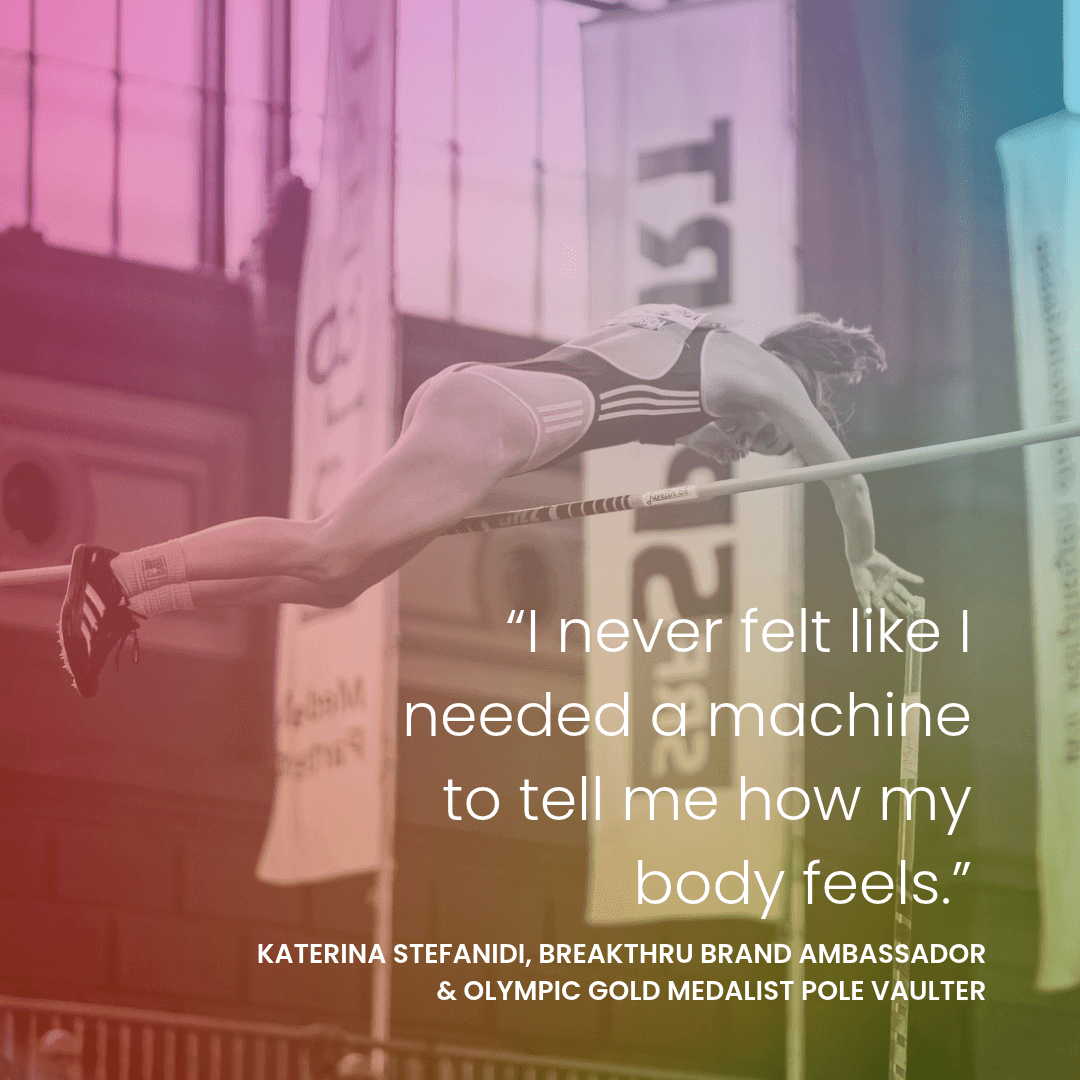
No. I never saw the value. I feel like I feel my body. The ones people use at night for quality of sleep, they're a little silly to me. Like, I wake up and I know how tired I am. I don't need to be told. I feel like that could very easily affect someone psychologically, going into a competition. Maybe you didn't feel tired so you wouldn't have noticed, but now you know that you've slept worse than someone else. I never felt like I needed a machine to tell me how my body feels.
I think it's crazy in general too, because I think the body always gives us cues. Your body is constantly telling you things. I'm on the other side where I want to tell people you need to learn to listen to your body and these tiny little cues.
How does balance play into your sport, is it relevant at all? How do you refine it?
There's different types of balances, such as balancing on the ground and balance on the pole.
We 200% train balance on the ground. As the years go by, I have started to slowly lift more and do more and more balance and core type of exercises. At first it was very simple—stand on one leg, somebody's throwing you a ball, and you try to keep a strong core so the ball doesn't push you off. Over the years we have added things like closing your eyes to make it more difficult. So 100%, balance is super important.
Is there anything about that balance training that influences your mental prep right before you jump?
100%. I think I've seen over time a correlation with when I do those exercises better, and I'm more balanced in those exercises in the warmup, I tend to perform better. There is a correlation to performance and psychology. I do wonder how much I've also created that in my head, where if maybe one day I do them and I'm not very balanced, I almost assume that I will not perform well. Maybe by doing them, I help myself perform slightly better.
You said something about sprinting and aging. What were you saying?
After 35 years old, less than 5% of adults sprint. It makes sense, right? In a corporate environment, why would you ever sprint after 35?
What about you, though, do you love sprinting? What does it feel like to you?
Growing up, pole vault consists of jumping, sprinting, and lifting. I did not care for any of the other training, I only did it because I had to. As years go by, and maybe partly because I was injured and I haven't been able to sprint as much, I have really appreciated sprinting. I do see how in the future you can get into a reality where you never sprint again.
When you sprint, there's a feeling of euphoria; it's something that you don't really feel with anything else, even any other type of exercise. Sometimes I hate how I feel after sprinting, how tired I am. I do feel like it's something that we will probably stop doing at some point in our lives. I just feel very happy to be able to do it, and I want to try to keep doing it as long as I can.
What about visualization? How does movement live in your mind?
For many years, probably the first 15 years of my life until I started working with Mitch as a coach, I didn't do structured visualization, but for sure, pole vaulting goes through my mind all the time. Especially as we get closer to an important competition or a championship, I will see myself in my head jumping a lot more.
When I started working with Mitch, he really wanted me to do a more structural visualization. For me, this was very hard, and I didn't like that kind of structure. But it always seemed like there was a correlation—when I started to do this structural visualization, I would start doing better.
As the years go by and I try to figure out better ways of having this structural visualization, I realized that I needed something between meditation and visualization. I needed some time to sit down, focus, and be in the moment. However, I do feel like during the day and especially in times of championships, without forcing it, I am visualizing pole vault in a much less structured way.
Do you think about your son discovering the kinds of movement and the kind of sport that he loves?
All the time.
What do you think about it?I think we are the crazy kind of parents that will for sure force him into sport. I could not imagine him not doing something relating to sport, whether he'll decide to do it professionally later, who knows.
We give him opportunities all the time. We've bought this little toddler ball launcher that throws balls in the air to hit them with a baseball bat. When we were in Greece in the summer I bought him a tiny little racket so that he can start caring about tennis. But he's so young, I'm sure that we can have this conversation every year, and I'll be able to give you more and more insight of how we feel and how we're letting him explore and the things we’re showing him.
Do you remember how your time at school felt in your body compared to this?
Yeah, for sure. Especially during my grad school years, I would always have the same injuries that had to do with my shoulders—probably because I was not in the best posture. I was constantly getting weird things in my shoulder, all the way down to the wrist because everything's connected and it's a chain. That was one for me, especially being on a computer.
The second is I've always had tight hip flexors, so the extra sitting was not the best. I remember very often I would get off my chair and push it to the side to do a hip flexor stretch or something like that.
It really was not the best for me. It was hard. I felt like at the time I was combining professional sport and studies well enough, but I think I was missing rest. I was able to do all the training and be good at my studies, but I was missing everything around the training to take me from top 15 in the world to go to the top potentially.
What are your feelings about moving outside versus moving indoors? Do you do any outdoor movement that is not related to pole vaulting?
If you ask my husband, he will tell you that I am a house cat. That being said, we mountain bike, we ski, we train outdoors a lot, and we compete outdoors. I grew up in Greece, so the whole summer we would spend at the sea. My husband has pushed me to do a lot of outdoor activities I probably wouldn't be doing otherwise, like skiing and mountain biking.
I actually enjoy competing outdoors a lot more than competing indoors. I very much like that outdoors you have elements that you have to fight—which is very hard—but I think it’s what I'm good at; they don't affect me as much as my competitors, so that makes me better.
I love what you were just saying about having to fight the elements. Can you talk about that a little bit more?
Obviously, you have rain, you can have the sun in your eyes, there could be a million different things. I would say the biggest thing for us in pole vault is the wind. Wind can be very tricky because if it's a little bit inconsistent, it can be moving your pole one direction or the other as you are running, and you can pretty much not finish the jump when that's happening. It’s very difficult. What people hate the most is when there is a headwind. You feel like you're running slower or it's like pushing you back. I think it does not affect me as much as others. What we have figured out is that the wind needs to be very, very strong to actually slow you down. What happens is people start to run differently trying to fight the wind, and that is what actually slows them down.
What we can learn from Katerina
We admire Katerina for everything that she's taught us. For the fact that, from a world light years away from those of us who sit at a desk, she can still remind us of the very most basic and important things about human potential and performance.
She has broken through the age barrier for her sport, and is the most awarded Greek female athlete of all time. She moves through each competition with humour, grace, and small dance breaks. She knows that the best jumps are in those moments where your mind and your body come together, your energy and focus are aligned, and you get exactly out of your jump what you put into it—not through effort, but through physics and flow. She’s an exemplar of what grit can result in. She knows the importance of rest, and knows exactly when to push forward versus when to pull back.
All these things are made possible by her strong sense of interoception, or ability to listen to each small cue from her body. Let Katerina be a reminder to you that the body and the mind belong together, whether it’s in the workday or on the field, to seize small moments of motion, and to learn to listen.
Breakthru in the World
Request a demo to learn how teams stay sharper, healthier, and more connected with Breakthru
See how science-backed, 2-minute microbreaks can boost focus, motivation, and resilience for your organization.
Join the
45,000+
corporations, educational
communities, and non-profits
worldwide using Breakthru.