Standing Up for a Break: Why Movement Belongs in the Workday
As technology continues to evolve and the pace of work accelerates, many leaders are asking the same question: How do we help people feel human in this new era of busyness?
Movement-based microbreaks are gaining momentum as a solution. Growing numbers of organizations are exploring how brief moments of movement can help employees sustain energy, focus, and creativity, and counter the negative health effects of prolonged sitting.
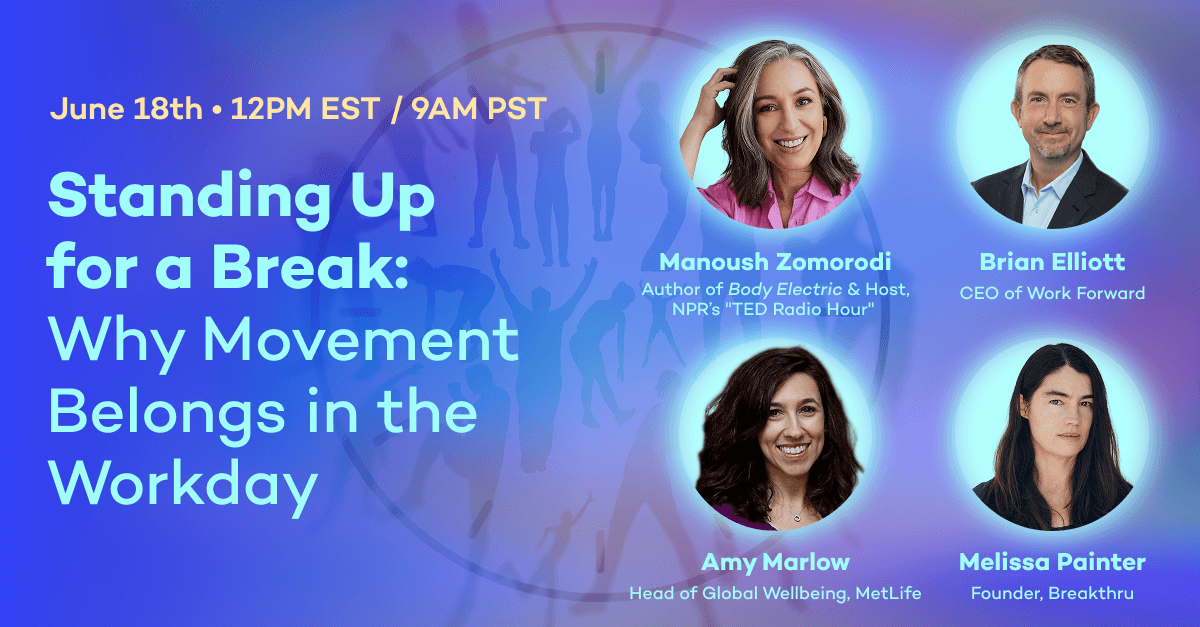
Manoush Zomorodi (Host, NPR’s "TED Radio Hour"; Author, Body Electric), Amy Marlow (Head of Global Wellbeing, MetLife), Brian Elliott (CEO, Work Forward), and Melissa Painter (Founder, Breakthru) joined together for a powerful conversation on the role of movement microbreaks in the workday.
This blog is a summary of that session, offering unique expert perspectives and actionable insights for bringing movement back into the flow of work.
The Science of Sitting
What Happens in Your Body and Brain When You Sit?
Have you ever wondered why you feel so foggy, irritable, drained, and achy after hours spent sitting still?
Manoush Zomorodi wondered the same thing. This question led her to Dr. Keith Diaz—a physiologist at Columbia Medical University Center—who was studying the minimum amount of movement the human body needs to counteract sedentary behavior and avoid negative health consequences.
His research found that just five minutes of gentle movement every half hour during sedentary time has outsized outcomes: it cuts blood glucose in half, significantly reduces blood pressure, and improves mood, focus, and productivity.1
Manoush likens the physical effects of sitting to your legs and torso becoming a kinked garden hose; when water tries to pass through, it gets backed up and pressure starts to build.
The same thing happens in your legs and torso when you sit. The flow of oxygen and glucose to the brain is reduced, glucose levels and blood pressure both rise, and your risk of chronic health conditions (such as diabetes and obesity) increases. It also explains the foggy and exhausted feeling we get from sitting: “we literally are not feeding our brain,” Manoush said.
Melissa emphasized the urgency of the conversation. Sedentary behaviour is a global health crisis, and it’s growing. The World Health Organization predicts that by 2030, sedentary lifestyle will result in 500 million new cases of preventable conditions (heart disease, obesity, diabetes, etc.), costing governments 27 billion dollars a year.2
The Science You Need to Know
The session opened with each panelist sharing the piece of science they wish everyone knew.
For Melissa, her favourite piece of science challenges a belief we’re taught from the moment we go to school as children: that thinking hard requires sitting still. In reality, it burns cognitive energy to sit still, and movement makes energy.3
Manoush referenced interoception, which is the brain-body conversation that enables us to accurately detect, interpret, and respond to internal signals.4 When we’re sucked into the flow of work and screens, we lose touch with our embodied intelligence and our interoceptive skills diminish.5
In the Body Electric study, participants were able to transition from requiring a timer to take their breaks to being able to accurately detect the signals from their body telling them they needed a break in just a few weeks—demonstrating that movement breaks re-train our interoceptive abilities.6
For Brian, it’s all about the combined cognitive and physical strain that long hours sitting in virtual meetings creates. He experienced this firsthand at Slack, as he helped teams navigate the shift from in-office to online work during the pandemic.
Finally, Amy’s favourite piece of science: the reason why our best ideas come to us when we step away. When your brain isn’t laser focused on a specific problem or goal (such as when on a walk) it can shift out of convergent thinking (focused, logical thinking) and into divergent thinking (expansive thinking where the mind can drift and form unexpected ideas and connections).7
“I think we’ve all had that experience where you’re in the shower, you’re walking the dog, and that’s when the big solution to your work problem comes to your mind. I just think that the fact that there's research to support that is so fascinating.”
The Science You Should Act On
During the session, an audience member asked for a simple version of the science to help more people understand the dangers of not moving and taking breaks.
Brian and Manoush both leaned into the physical consequences of sedentary behaviour. Sitting for 6 or more hours a day increases mortality rate by 17% for men and 34% for women.8 The average 19-year-old generally moves about as much as the average 62-year-old now.9 Type 2 diabetes has doubled in young people over the last 20 years.10
Meanwhile, Melissa shared the flipside: the incredible design of the human body, that such a small amount of movement has such outsized impact and can re-engage all these systems.
“If you can educate people on short movements have such an outsized benefit, that starts to feel achievable.”
Shifting the Culture around Movement Breaks
When Movement Breaks Become Company Culture
What motivates a global enterprise to incorporate movement breaks into their company culture?
MetLife’s interest in movement breaks dates back to the pandemic. With a fundamental change in the workdays of much of their global population, many people reported feeling the pace of work suddenly accelerated, and found they were sitting for longer periods of time.
This led to MetLife considering more closely how they could support their employees in the flow of the workday—not just through benefits and wellness programs—but also to manage their energy and focus throughout the day. Sitting for so long comes at a cognitive cost, which MetLife wanted to counteract, and they believed helping their employees take short breaks was a simple but effective way to do so.
Similarly for Brian, the value of breaks emerged out of his experience in leadership at Slack during the pandemic. In the summer of 2020, cognitive and physical strain from the number of days spent sitting in Zoom calls became apparent. So, they began experimenting with how they could get people away from their desks more throughout the day despite remote work, such as with virtual walk-and-talks.
What Does it Take to Shift the Culture Around Breaks?
The conversation called out the broader culture shift required. There can be significant resistance to break-taking, at an organizational level, a team level, and a personal level.
Amy identified the mounting pressure facing employees (through productivity, performance, and digital lives), combined with the deep-rooted perception that they need to be constantly heads-down working, as one barrier.
While we all know regular breaks are important for our health and cognitive performance, we still need explicit permission from our leaders to feel we can act on them.
When MetLife first piloted their microbreak tool, Breakthru, it gave them the opportunity to take a deep dive into their employees experiences and beliefs around breaks and they found that their employees felt they needed explicit permission and support from their leaders in order to take breaks.
Support from supervisors influences not only employee's willingness to take breaks, but also increases the positive effects of microbreaks, leading to higher levels of recovery and positive affect.11
Beyond leader support, Amy also identified the need to build a strong personal and team-level habit around taking them.
While Amy shared there is no ‘secret sauce’ to overcoming these barriers and shifting the culture around breaks, she shared some of her own best practices for doing so.
To overcome the habit barrier, Amy introduces recovery rituals—systems in the workday to take breaks and build the habit. Some recovery rituals she recommends include setting timers and reminders so you know when it’s time to take a break, and ending meetings five minutes early to build breaks into your calendar.
Direct employee engagement has been a powerful strategy for Amy. She does frequent ‘wellness roadshows,’ partnering with chiefs of staff, HR business partners, and line of business leaders to present at their team meetings and events about breaks, and to introduce them to MetLife’s microbreak tool. Consistency is key in this approach, and Amy spends as much time with employees and talking about breaks as possible.
Peer-to-peer storytelling and encouragement has been another important approach. Amy shared how when colleagues hear the benefits they experience from taking breaks from each other (e.g., “I’m more energized at 3pm”), and when the invitation to take a break comes from a colleague, it becomes a self-perpetuating habit.
Manoush echoed the importance of leader support, adding her own insights from the Body Electric study. There is a tremendous culture shift required, and only leadership can truly enact it:
“From the minute we go to kindergarten, we are told that sitting and staring straight ahead is what productivity looks like…you can read the science, you can believe the health benefits, but to not think that people are judging you because you're not sitting, typing away, that's the big thing that has to be changed. And only the people at the very top can give that permission, whether it's explicit or just in walking the walk, quite literally.”
Brian emphasized the deep-rooted and challenging cultural bias towards breaks: “The hustle culture thing has been with us forever; it’s not just the 2nd graders being told to sit still, it’s the fact that we’re expected to always be on.”
He referred back to a Slack case study that found that just 38% of their employees felt comfortable taking breaks—not just if they were taking them, but if they felt it was acceptable to do so. In a 2-week experiment across 200 employees, role-modeling and encouragement from colleagues and leaders increased this value 60%.12
How To Take an Effective Movement Break
One audience member asked: what kinds of movements are the most effective?
Each panelist responded from their own experience.
When Brian is in deep focus, he finds it difficult to want to pull himself out. However, he knows he reaches a point (after an hour or so) where his work starts to get sloppier and he knows he needs to step away. The most effective movement for him is the one that enables him to leave the room and his devices—whether that’s grabbing a snack, saying hello to his spouse, or going into the backyard.
He also shared how he’s altered his desk setup to be more conducive to movement: a stool to sit on instead of a chair to improve balance, a footstool underneath his desk to do calf raises, and a standing desk option.
“I'm not an expert in this, but it's just the joys of over the years figuring out, like, I know I've got to move if I'm stuck back-to-back in meetings, what am I going to do?”
Amy calls her own practice the ‘baby rock’ as it is a similar motion to rocking a baby. She also enjoys heel and calf raises, which supports blood sugar control.
She recognized the challenge of working in a role with frequent virtual meetings, and shared her practice of swaying during meetings. She will often tell her team “I’m going to stand up and sway, and you’re going to get dizzy watching me, so I’m turning my camera off.”. Which, she added, helps make movement a team norm.
Manoush is a big fan of the ‘Zoom shuffle,’ bobbing side-to-side during virtual meetings, as well as little squats and heel raises.
In the Body Electric study, many participants used their breaks as permission to get off their screen. The study found those who got out into nature reaped additional benefits from their breaks.13 Participants working from home often used their breaks as an opportunity to clean their homes in 5-minute increments. Another, slightly more extreme, strategy she heard was getting a dog.
Melissa echoed the benefits of nature-based breaks: “If you can, as Amy says, “get outside and touch grass,” do it.”
However, for many workers it’s simply not an option; they can’t leave their desks, they only have a couple minutes, or there’s no nearby nature. The research on which Breakthru is based found that guided, immersive, and interactive movement breaks that pulls users out of their screens and into nature’s sounds and visuals is an effective compromise.14,15
Melissa also shared how simple, guided movements can help build body knowledge. When movement sequences blend yoga, dance, and martial arts, they can help people expand their balance, breathing, and mobility. Learning new movements enables curiosity and helps build mastery, which helps people stick with a movement practice.16
What Kinds of Work Benefits from Movement Breaks?
Movement breaks are relevant to every kind of work, whether you work in a seat or on your feet.
For desk-based workers, movement breaks provide valuable opportunities to break up long periods of sitting, ease the cognitive strain of screen-based work, and support sustained energy and focus throughout the day.17
Manoush suggests desk workers think of themselves as ‘information athletes.’ Just as athletes support sustainable long-term performance with rest, we need to do the same with our brains.
“Your brain is what you do…if you build in breaks you will be more efficient and the quality of your work will be improved.”
Two sentiments often heard from Body Electric participants back this up: movement breaks made them not hate their job, and actually made them better at it.18
Meanwhile, movement breaks can benefit people who work on their feet by easing the physical strain of repetitive movements,19,20 improving bodily awareness,21 and supporting energy, attention, and mood.22
What Happens When Teams Take Movement Breaks Together?
One question posed during the session was about teams moving together—something Manoush does in TED Talks.
Shared movement is something MetLife encourages for their employees. Leaders help enact this, such as with walking meetings and screen-free meetings. Amy referenced a particular team in Mexico that started running together; employees on the team reported stronger feelings of support from their leader as a result. Amy also made the important distinction of being cognizant of varying physical abilities and comfort levels to ensure inclusivity.
Brian, too, practices this. During his session at a recent Charter event, he called upon the room to put their devices down, stand up, stretch, to get their attention going and blood flowing again, before diving into the content of his session.
Manoush made a practical suggestion for how you can incorporate shared movement into your team’s day: “Boring presentations, definitely stick in a movement break. It changes the vibe and the mood.”
There is a science behind the benefits of moving together as a team. When we move in sync, even if it's with strangers, we subconsciously indicate to each other that we're willing to cooperate.23,24
Who’s Responsible Bringing Movement Breaks Company-wide?
One audience member made an important callout: wellbeing programs and workplace wellbeing programs are often siloed responsibilities in organizations. Enacting movement breaks at scale across an organization, as discussed in the session, requires an integrated approach between benefits, real estate, and other departments.
In Amy’s own experience, breaking through the silo is important. To accomplish this, her approach has been to partner outside; rather than staying in her benefits/wellbeing space, she partners with broader HR leadership, across teams, and with line of business leaders. This approach has helped movement breaks successfully spread across the organization.
Brian gave a call-to-action for leaders: don’t leave caring for your team to HR or Workplace.
“It’s your responsibility because their performance is your performance. If they’re not in a good space, then you’re going to have a struggle on your hands. So don’t outsource it to another function and believe you’re going to solve the problem.”
Why is Movement Having a Moment Now?
A 2026 study from Boston Consulting Group revealed a new challenge facing tech-based workers: AI brain fry.
AI brain fry is a unique form of cognitive overload emerging in heavy users of AI, from marshaling cognitive oversight beyond capacity. It’s associated with both a 39% increase in desire to quit, and a 39% increase in major errors.25
While breaks may not be a direct cure for AI brain fry, they can help alleviate the symptoms of it. Brian referred to them as ‘circuit breakers’ that create breathing room for workers to step back, refresh, and evaluate.26
“The deeper we go into the uses of AI, the more that we're gonna realize, we don't operate at machine speed. We think we operate at machine speed, but we do not, and there's no way for us to keep up with machine speed.”
AI brain fry is a topic Amy is leveraging in her wellness road shows. Beyond cognitive overload and sustained mental output, the current moment also poses the challenge of the psychological impact from such significant change and uncertainty, as workers grapple with what AI will do to their roles.
Amy shared how she is supporting employees in the face of this, partnering with MetLife’s learning and development team to ensure AI learning content includes language around rest, recovery, and breaks.
“There’s all these really basic human things that don’t have anything to do with the speed of work and the technology itself, but more about our experience as people in jobs. So, all the more reason why people’s stress and tension are building, putting them more at risk for burnout. Having recovery, rest, and breaks is a basic, fundamental way you can counteract that”
Manoush referenced an op-ed she recently published in The Guardian with Keith Diaz that warns of the dangers of offloading tedium to AI.
“Every time we have introduced a new innovation or technology to increase efficiency, we’ve actually detracted from the need to use the human body….we still have this fantasy being peddled that AI will set us free and suddenly we’ll have time to take all the pilates classes we want and frolic through fields. That has never, ever happened in the history of technological innovation.”
She also remarked how prior to the industrial revolution, humans never needed to ‘get into nature’ because nature was simply a naturally occurring part of our daily experience. Manoush believes we’re at a similar moment now with movement and thinking:
“People need to schedule it. They need language around it and need to be intentional about it, because technology will crowd it out. Judgement, decision making, thinking, all of these things that are getting outsourced. How do we begin to put more formal structures around them and integrate them into our day purposefully?”
Take a Movement Break?
Manoush concluded the session with her ultimate motivation behind moving more: “I wanna feel good in my body and I wanna be joyful and thinking straight for as long as possible.” — an important reminder for us all.
Movement breaks are emerging as an important part of organizational culture, as a tool to counteract sedentary behavior and cognitive overload. By deliberately building movement breaks into your day, you can support physical health and cognitive performance, while encouraging your team and colleagues to do the same.
For more information...
- Manoush Zomorodi: purchase your copy of Body Electric and subscribe to Manoush Minutes on Substack.
- Amy Marlow: follow Amy on LinkedIn.
- Brian Elliott: subscribe to Work Forward on Substack
- Melissa Painter: follow Melissa on LinkedIn, and learn more about Breakthru's movement-based microbreaks.
Watch the recording:
- Diaz, K. (2026, March 16). Built to Move: Redefining Everyday Health. Irving Institute for Clinical and Translational Research. https://www.irvinginstitute.columbia.edu/news/built-move-redefining-everyday-health
- World Health Organization. (2022, October 19). WHO highlights high cost of physical inactivity in first-ever global report. Www.who.int. https://www.who.int/news/item/19-10-2022-who-highlights-high-cost-of-physical-inactivity-in-first-ever-global-report
- Albulescu, P., Macsinga, I., Rusu, A., Sulea, C., Bodnaru, A., & Tulbure, B. T. (2022). Give me a break! A systematic review and meta-analysis on the efficacy of micro-breaks for increasing well-being and performance. PLoS ONE, 17(8), 1–27. https://doi.org/10.1371/journal.pone.0272460
- McDonough, M. (2024). Making Sense of Interoception | Harvard Medicine Magazine. Magazine.hms.harvard.edu. https://magazine.hms.harvard.edu/articles/making-sense-interoception
- Wallman-Jones, Amie & Nigg, Carina & Benzing, Valentin & Schmidt, Mirko. (2023). Leave the Screen: The Influence of Everyday Behaviors on Self-reported Interoception. Biological Psychology. 181. 108600. 10.1016/j.biopsycho.2023.108600.
- Diaz KM, Murdock ME, Serafini MA, et alEvaluating movement breaks as a public health strategy to mitigate the harms of prolonged sitting: a large-scale pragmatic interventionBritish Journal of Sports Medicine Published Online First: 23 June 2026. doi: 10.1136/bjsports-2025-111221
- Wong, M. (2014, April 24). Stanford study finds walking improves creativity. News.stanford.edu. https://news.stanford.edu/stories/2014/04/walking-vs-sitting-042414
- Patel AV, Bernstein L, Deka A, Feigelson HS, Campbell PT, Gapstur SM, Colditz GA, Thun MJ. Leisure time spent sitting in relation to total mortality in a prospective cohort of US adults. Am J Epidemiol. 2010 Aug 15;172(4):419-29. doi: 10.1093/aje/kwq155. Epub 2010 Jul 22. PMID: 20650954; PMCID: PMC3590043.
- Varma, V. R., Dey, D., Leroux, A., Di, J., Urbanek, J., Xiao, L., & Zipunnikov, V. (2017). Re-evaluating the effect of age on physical activity over the lifespan. Preventive Medicine, 101, 102–108. https://doi.org/10.1016/j.ypmed.2017.05.030
- The Lancet Diabetes & Endocrinology Alarming rise in young-onset type 2 diabetes The Lancet Diabetes & Endocrinology, 2024; 12433 https://www.thelancet.com/journals/landig/article/PIIS2213-8587(24)00161-X/fulltext
- Nie, Q., Zhang, J., Peng, J., & Chen, X. (2023). Daily micro-break activities and workplace well-being: A recovery perspective. Current Psychology, 42(12), 9972–9985. https://doi.org/10.1007/s12144-021-02300-7
- Sarasohn, E. (2024). Case study: what happened when we took a break at Slack. Slack. https://slack.com/blog/productivity/case-study-what-happened-when-we-took-a-break-at-slack
- de Bloom, J., Kinnunen, U. & Korpela, K. Exposure to nature versus relaxation during lunch breaks and recovery from work: development and design of an intervention study to improve workers’ health, well-being, work performance and creativity. BMC Public Health 14, 488 (2014). https://doi.org/10.1186/1471-2458-14-488
- Chorong Song, Harumi Ikei, Yoshifumi Miyazaki, “Physiological Effects of Nature Therapy: A Review of the Research in Japan,” Int J Environ Res Public Health. 2016 Aug; 13(8): 781, doi: 10.3390/ijerph13080781
- Florence Williams, “The Nature Fix,” W. W. Norton & Company; 1st edition (February 7, 2017)
- Sargent-Cox KA, Butterworth P, Anstey KJ. Role of physical activity in the relationship between mastery and functional health. Gerontologist. 2015 Feb;55(1):120-31. doi: 10.1093/geront/gnu042. Epub 2014 May 21. PMID: 24847845; PMCID: PMC5994882.
- Chandrasekaran, B., Pesola, A. J., Rao, C. R., & Arumugam, A. (2021). Does breaking up prolonged sitting improve cognitive functions in sedentary adults? A mapping review and hypothesis formulation on the potential physiological mechanisms. BMC Musculoskeletal Disorders, 22(1), 1–16. https://doi.org/10.1186/s12891-021-04136-5
- The Commonwealth Club World of Affairs. (2026, May 8). Manoush Zomorodi and Melissa Painter: The Hidden Health Costs of the Digital Age. YouTube. https://youtu.be/vVwrKT45DbE?si=qM1FYxTUmdpm7wyy
- Beltran Martinez, K., Nazarahari, M., & Rouhani, H. (2023). Breaking the Fatigue Cycle: Investigating the Effect of Work-Rest Schedules on Muscle Fatigue in Material Handling Jobs. Sensors, 23(24), 9670. https://doi.org/10.3390/s23249670
- McLean, L., Tingley, M., Scott, R. N., & Rickards, J. (2001). Computer terminal work and the benefit of microbreaks. Applied Ergonomics, 32(3), 225-237. https://doi.org/10.1016/S0003-6870(00)00071-5
- Faleye, O. (2026b, February 24). Proprioception at Work: The Invisible Sense That Shapes Safety, Performance, and Recovery - iOH - The Association of Occupational Health and Wellbeing Professionals. IOH - the Association of Occupational Health and Wellbeing Professionals. https://ioh.org.uk/2026/02/proprioception-at-work-the-invisible-sense-that-shapes-safety-performance-and-recovery
- Bergouignan, A., Legget, K.T., De Jong, N. et al. Effect of frequent interruptions of prolonged sitting on self-perceived levels of energy, mood, food cravings and cognitive function. Int J Behav Nutr Phys Act 13, 113 (2016). https://doi.org/10.1186/s12966-016-0437-z
- Andersen, L.L., Skovlund, S.V., Vinstrup, J. et al. Potential of micro-exercise to prevent long-term sickness absence in the general working population:prospective cohort study with register follow-up. Sci Rep 12, 2280 (2022). https://doi.org/10.1038/s41598-022-06283-8
- Barbara Ehrenreich, Dancing in the Streets, Holt Paperbacks; 1st edition (December 26, 2007)
- Bedard, J., Kropp, M., Hsu, M., Karaman, O., Hawes, J., & Rosen Kellerman, G. (2026, March 5). When Using AI Leads to “Brain Fry.” Harvard Business Review. https://hbr.org/2026/03/when-using-ai-leads-to-brain-fry
- Elliott, B. (2026b, March 18). AI Brain Fry. Substack.com. https://open.substack.com/pub/theworkforward/p/ai-brain-fry
Breakthru in the World
Request a demo to learn how teams stay sharper, healthier, and more connected with Breakthru
See how science-backed, 2-minute microbreaks can boost focus, motivation, and resilience for your organization.
Join the
45,000+
corporations, educational
communities, and non-profits
worldwide using Breakthru.