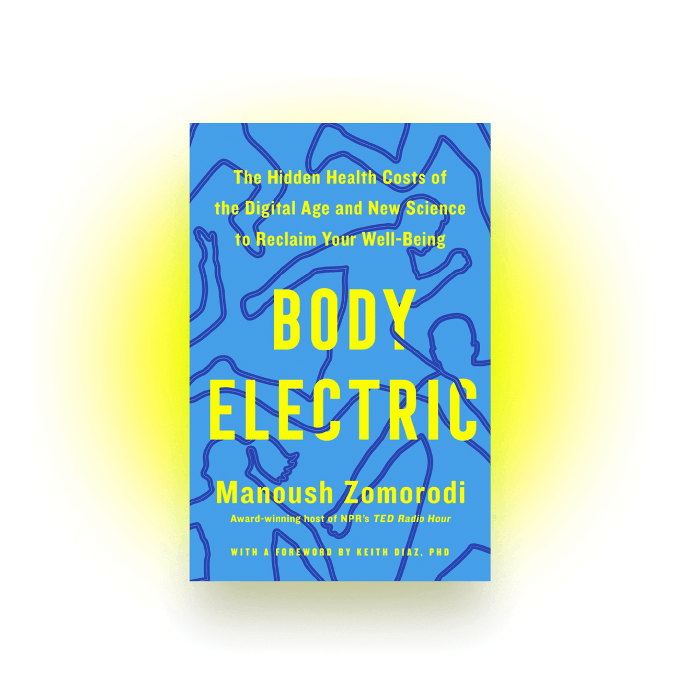
Manoush Zomorodi and the Hidden Health Costs of the Digital Age
For Manoush Zomorodi, the Body Electric journey started during the Covid-19 pandemic. She was curious why, despite being safe and healthy indoors, she ended each day with barely enough energy left to close her laptop, crawl to the couch, and watch Netflix. That question inspired a search to answer another: why does all this time on screens leave us so physically exhausted, despite how little we move while on them?
Through eye-opening research and a groundbreaking study in partnership with NPR and Columbia University Medical Center, Manoush sought the answer to that question. Her findings are now widely available in her new book, Body Electric.
As Manoush Zomorodi brings this book out in the world, we’re proud to stand alongside her.
Breakthru founder, Melissa Painter, joined Manoush at the Commonwealth Club of California San Francisco for a conversation on the cognitive and physical impacts of our sedentary, screen-saturated lives, and the incredible benefits just a few minutes of movement can have in preventing and reversing them. This blog is a summary of that conversation.
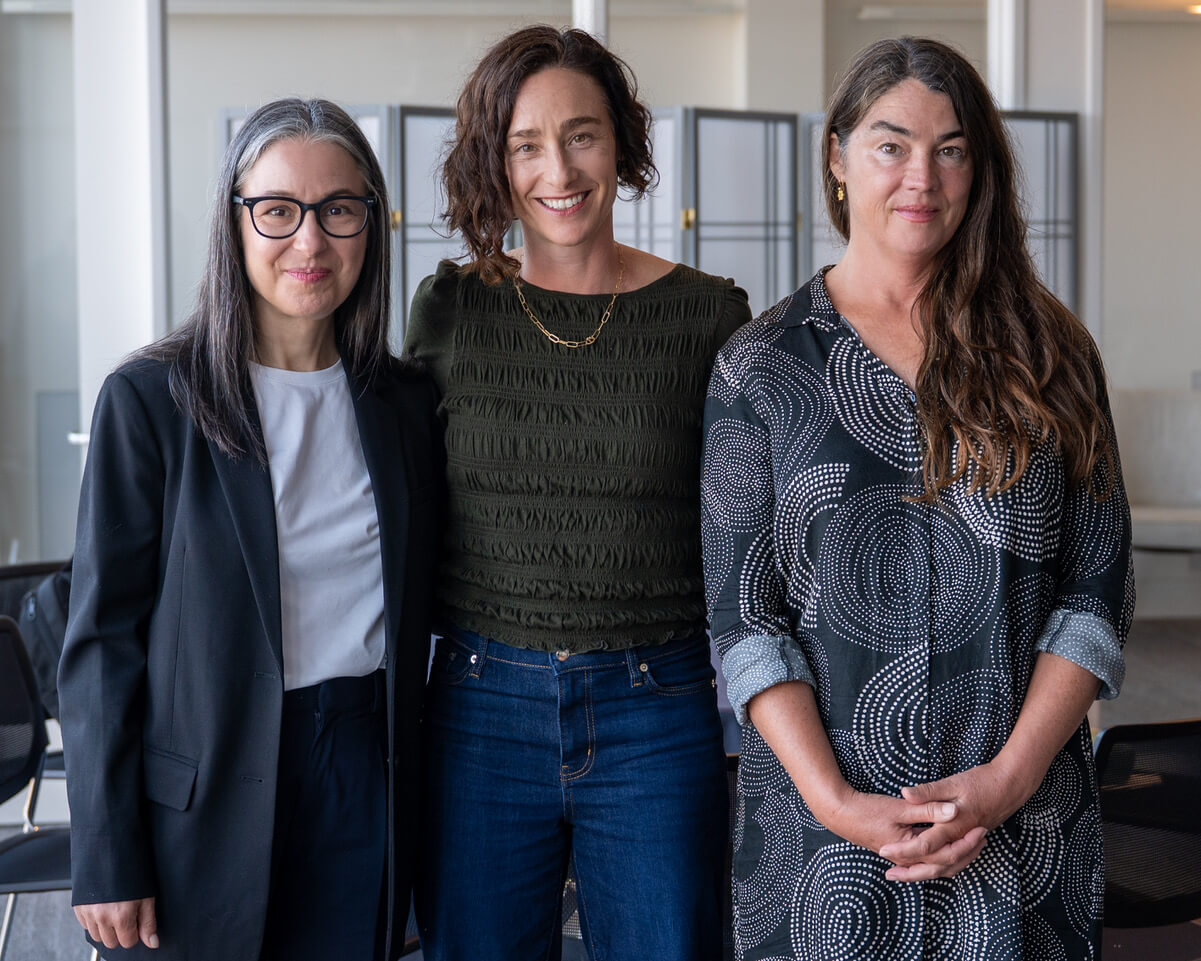
Photo: Ed Ritger
The Body Electric Study
Manoush’s quest for understanding of the biological and physical health implications of all this time spent sitting and looking at screens led her to Dr. Keith Diaz, a physiologist and researcher at Columbia University Medical Center. Dr. Diaz’s research is focused on understanding the minimum daily amount of movement the human body needs in order to sustain health and prevent premature death. His research finds that five minutes of gentle movement every 30 minutes carries outsized benefits—reducing blood glucose, lowering blood pressure, and improving concentration and mood.1
Manoush put his research to the test herself, comparing days where she worked with and without these five minute movement breaks every half hour. She was astonished by her results: on the day she took those breaks, her blood sugar was cut in half, her blood pressure dropped by five points, she rated the quality of her work higher, felt less anxious, and had more energy.
She described the difference she felt to the audience:
"I was kind of impressed at emotionally how I felt different. I was able to concentrate the whole day. I wasn't as anxious by the end. I had energy at the end of the day to go home and make a nice dinner for my family... But what really shocked me were the results that he gave me: my blood sugar was cut in half, my blood pressure dropped by five points, and I rated the quality of my work as higher on the day that I had all these interruptions."
This led to the launch of the Body Electric Study, in partnership with NPR and Columbia University Medical Center. The aim of the study was simple: to expand the sample size to test the benefits of regular movement breaks, as well as to test the feasibility of taking them. More than 23,000 participants joined the study, incorporating five-minute movement breaks into their routine every half hour, every hour, or every two hours, for two weeks.2
80% of the participants made it through the first two weeks of the study. 82% enjoyed taking the breaks. Fatigue dropped by 28%. Participants reported they felt like they were back in their bodies again, they regained their ability to focus, they no longer hated their jobs. Productivity rose. One particular participant was even able to start tapering off her insulin, had her blood pressure drop by 40 points, and was inspired to make improvements in other aspects of her health (she is now a certified health coach).2
The Health Consequences of Sitting
So, what actually happens in our bodies when we sit? As Manoush describes it: "your body is like a kinked garden hose. It is kinked at your torso and at your knees and if you think of a kinked garden hose when water is coming through, pressure begins to build up. This is blood flow that gets stopped."
Even the standing desks aren’t the health-hack they are often touted to be: "the problem is leg muscles need stimulation, only when they're stimulated and they act like a sponge and suck in the glucose and lipids that is in the bloodstream and also push the oxygen up to your brain."
Then, there are the ‘active couch potatoes’, as Manoush calls them—the people who routinely exercise in the mornings, evenings, or on the weekends, but then spend the majority of the rest of their time sitting. One burst of movement does not undo hours of sitting; you’re still at risk of the chronic health issues of a sedentary lifestyle.
Interoception and Movement Breaks
"Why did I have this disembodied sense that like, almost like I was like a brain with like a, like a brainstick with like a flesh bag attached?"
Interoception is the body’s ability to sense, interpret, and respond to internal signals, helping us understand how we feel and what we need, physically and emotionally.3 Some such signals can be subconscious, like taking another breath. Some signals are more explicit: your back hurting, anxiousness, and feeling dazed like you just left the movie theatre are all subtle ways your body asks for a break. Movement breaks are a simple way to get back in touch with your interoception, to gain a better sense of your physical needs.
Interoception also has key impacts on our cognitive performance; it’s what makes us multisensory thinkers. Melissa tied it back to walking: we can’t take in all the information we encounter while on a walk; our brains were designed to process this information in a subliminal way and to only surface what is truly important. Similarly, interoception helps us discern key signals out of all the subconscious processes in our bodies.
It’s why we have gut feelings for a new hire or can be the first to uncover patterns in a diagnosis. When you’re disconnected to your body, your interoception is inhibited and you miss out on these important signals.
What Is the Best Kind of Movement Break?
There is no one-size-fits-all approach to movement breaks; the kind of movement you’re doing matters far less than you may think. It’s all about incorporating more movement into your day in general.
Keith Diaz’s research uses walking as it is free and accessible. Breakthru blends together movement practices such as tai-chi, yoga, and dance for their mood-boosting, balance building, meditative benefits. But really, it’s simply about moving more in general.
Some people do a chore. Some people march in-place while in meetings. Some let out their dog. The best kind of movement is the kind that works best for you in the flow of your day.
This is one of the reasons Breakthru introduced its Break Away feature earlier this year. We often hear from our dedicated community of movers that they use Breakthru to build their break-taking habit, using Reminders to ensure they never forget to take breaks, but instead choose to spend their break time doing something different and away from their screens. We built Break Away with these insights in mind; you can set Reminders, and continue to build your History and fill your orb, all while taking the unique kind of break you need in that moment.
As Manoush said: "The goal is not to turn people into robots where like, ‘must take break’...The point is like, do I need a break now? Is it going to work for me right now?...The idea is not to have fitness, it is just to feel a little better in your body. It is something you get to do, not have to do."
It all ties back to interoception—becoming familiar with the internal signals your brain and body provide to tell you exactly when you need a break, and what kind of break you need.
One final point on the different kinds of movement: in the conversation, moderator Leslie McClurg asked specifically about yoga and tai-chi movements—two of the several forms of movement blended together in Breakthru’s breaks. Melissa noted the particular benefits of these movements in building balance and range of motion, improving mood, and supporting longevity.
How Are Movement and Creativity Connected?
There are more than just physical benefits to movement; there are cognitive ones too. Have you ever stumbled upon a brilliant idea while on a walk? It’s not a coincidence. Our greatest ideas tend to come to us while we’re in motion. But why is that?
As Melissa explained:
"It's a really fascinating and beautiful thing, the degree to which movement and creativity and fresh ideas are tied together. There's a couple things going on when you're walking. One is that you are getting just enough external stimuli, that you're it's soft fascination. So part of your monkey mind, your fast brain is getting relaxed by that. So the deep thinker, the part that is able to solve a problem or come up with a poem or come up with a fresh idea, can't reveal itself. And that's why we have these moments of flash of inspiration."
Manoush expanded on the subject—something tackled in her first book, Bored and Brilliant, which explains the deep connection between boredom and creativity and how specifically allocating time to be bored and let your mind wander can be a productivity tool.
Manoush shared that, when we’re bored, the default mode network in our brains is particularly active. This is the network of brain regions responsible for generative thinking, problem solving, and autobiographical planning (the ability to intentionally and thoughtfully design one's life). Manoush summed it up by saying "being productive requires doing nothing."
Melissa also noted that the increasing drive and pace of technology makes moments of boredom and mind wandering harder to come by, thus hindering our abilities to generate novel constructive ideas and solutions, to organize information, and to learn new things.
AI Brain Fry
Research from BCG coined the phrase “AI brain fry” to describe the state of acute mental fatigue resulting from pushing cognitive oversight beyond its capacity.4 It is already affecting 14% of U.S. workers, and is associated with significant increases in major errors and intention to quit.5
AI is supposed to lighten the workload, but it is instead increasing both the volume of work and pace at which work is expected to be completed, as workers are being asked to oversee the work of more and more AI agents.
As with any technological innovation, the point of AI is to increase efficiency, to demand less from the body or brain. We’ve accomplished this so well that we’ve almost entirely engineered movement out of our days. Manoush raised the fascinating point that, prior to the Industrial Revolution, no one said they ‘needed to go out into nature’, because nature simply played a greater role in everyday life. She likened it to David Foster Wallace’s 2005 commencement speech “This Is Water.”
Manoush suggests that we need to intentionally ask each other if we got movement in each day, and to name it intentionally, because we as humans tend to excel at creating efficiency traps that cause us to neglect other things that are biologically imperative.
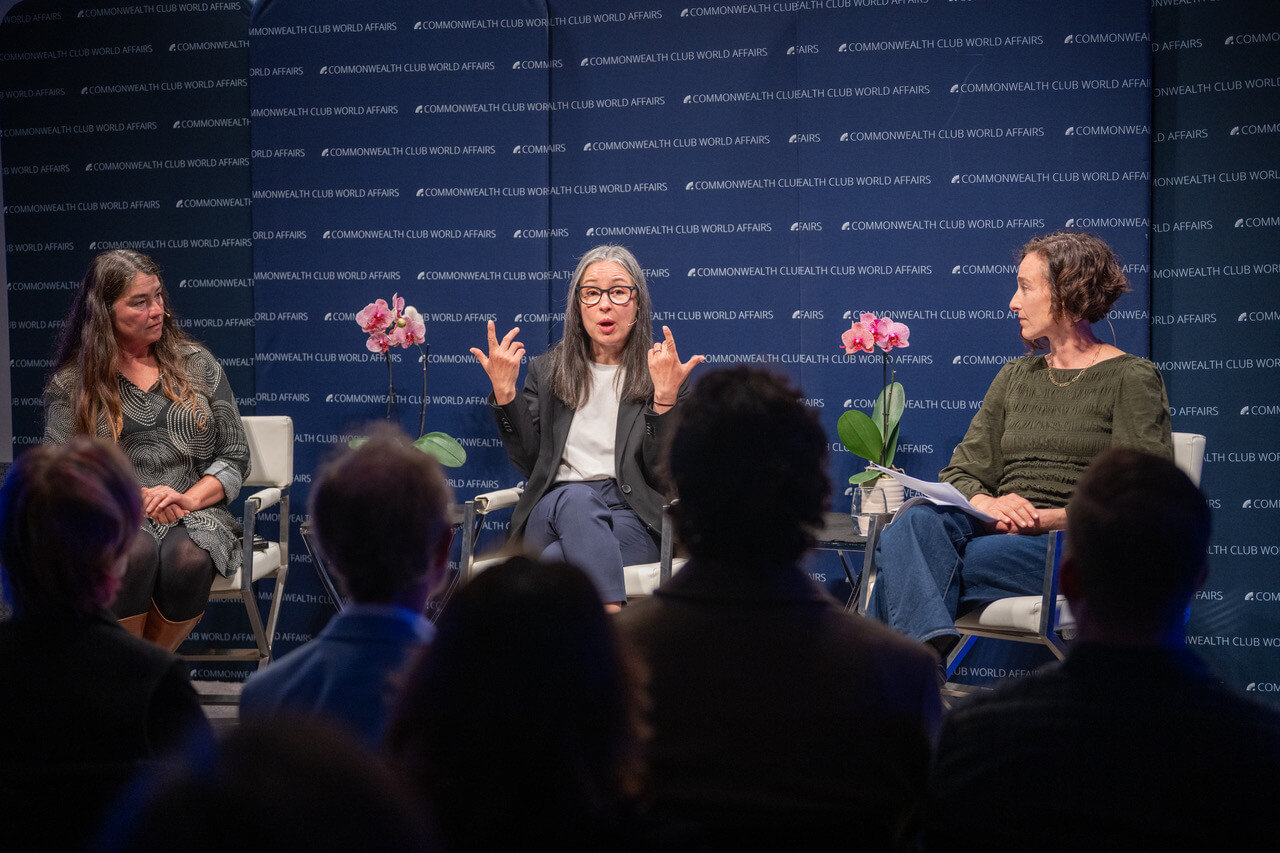
Photo: Ed Ritger
Who Leads the Charge on Movement in the Workplace?
We’ve talked about the physical and cognitive benefits of movement microbreaks in the workday. But who is responsible for actually implementing them?
Too many organizations leave it up to the individual employee. This is not a feasible strategy.
In order for employees to successfully incorporate movement into their workdays, they need to feel their workplaces and leaders support them in doing so. When we’re unsure if breaks are permitted, we are less likely to take them, ‘pushing through,’ even when we know we need one. And, it’s often the employees who need a break the most, who are at risk of burnout, who aren’t taking them.
However, the minute leadership steps in and takes an active role, everything changes. When leaders are explicitly supportive and encouraging of breaks, and especially when they model the behaviour themselves, employees' propensity to take breaks increases significantly.
The problem is that movement breaks don’t fall into any traditional budget line-item, nor is implementing them confined to one specific team or department within an organization. This is why the onus too often falls on individual employees to make the change, and is when it becomes another task on their list or demand on their free time—which generally means it does not get done.
As Melissa explained:
"We knew that the people who most needed breaks were the ones not taking them. They were the nurses. They were the, you know, working single moms. They were the type of leaders who were grinding. They were not going to make that decision on their own. They needed to have something come into their lives the same way there was coffee in the break room. I mean it needed to be operationalized. The minute it's an individual's responsibility, it's like, oh, it's well being. Who is that for? You either have to pay for it or you have do it in free time, and it doesn't fit in my life."
Another question was: what happens when executive-level leadership are skeptics? Or, are downright against movement breaks?
Melissa responded sometimes, they just need to hear the voices of the people they lead.
Every Friday in the Breakthru app, users are prompted to share back a word describing how they feel after taking their movement microbreak. The words that are shared back are brilliant and powerful: “fearless,” “I feel ten years younger,” “I have the energy to make it through the rest of my day,” “I feel like I’m back in my body.”
What are Manoush and Melissa’s Movement Break Protocols?
In case you’re curious, Manoush and Melissa both really do ‘walk the walk’ when it comes to movement breaks.
Manoush admitted she almost felt guilty in writing her book as it meant significant time spent sitting in front of a screen—the very thing she was writing against. Fortunately, thanks to her acute awareness of the subject and a strong sense of interoception, taking regular movement breaks in-the-flow of writing was not a problem: “My body tells me every 45 minutes, I am like a squirmy eight year old boy who has to move.” And, she felt significantly better after each time she returned from a movement break.
Manoush even took it a step further, undertaking an experiment while recording the audiobook of "Body Electric". The first time she recorded an audiobook, for "Bored and Brilliant", she and her producer powered through without breaks. She recalls the experience as being horrible, and noted how she could not feel her face by the end of each day and crawled to the finish. This time, she made sure to take the regular movement breaks she was speaking about, and they finished the recording in a mere three and a half days—a day and a half ahead of schedule—and felt amazing by the end of it.
Manoush described it as inertia—a resistence to the change of taking movement breaks: “the human body wants inertia. May I speak for myself? I want inertia. But I feel so much better. and alive and sparky when I get in these movement breaks.”
And for Melissa, she uses movement breaks as a tool to shift her mood and to prevent her from holding her breath throughout the day. She takes her movement breaks with Breakthru, with a walk to the coffee shop a block away, or by taking her dog to the beach.
Email Apnea
Speaking of breath, many of us are unknowingly suffering from Email Apnea.
Simple routine tasks like checking email cause us to hold our breaths, thus inhibiting the flow of blood and oxygen to the brain, resulting in Email Apnea.
It’s a fascinating condition. Your body knows you need to focus on a task, and so it diverts energy away from certain subconscious tasks (such as breathing) to direct more energy towards the task at hand. In the moment, it doesn’t sound all that serious, but it disrupts flow of oxygen and sets off our fight-or-flight stress response—leaving us feeling fatigued and anxious.
It was a retired tech executive, Linda Stone, who coined the term.6 Manoush interviewed Linda on the Body Electric podcast to explore the subject in detail.7
Linda was suffering from chronic respiratory issues, and realized she was holding her breath while in her email. She experimented, bringing in people to measure their breath while working. Participants included people in all kinds of work—dancers, professional musicians, airline pilots, and information workers—and what she found was that people who used their body in their work were the only ones who seemed to maintain breath-body connection while working.
Manoush, who keeps a kazoo on her desk to regulate her breathing, explained:
“If you're an airline pilot, you're self-regulating, because people bought you on the line. If you play the cello, you know how to use your body to get the best sound out of your instrument.”
Manoush concluded her thoughts on the subject with a call to action, to the group she refers to as ‘information athletes’: “Information workers, we need to think of ourselves as information athletes. We need to use our body and aren't okay, so sure our tool is Google Docs. But I think it can be very helpful to think that our instrument is our brain, right? When we're trying to get the best out of our cognitive abilities and that connection between being able to think and not feel foggy and be able to concentrate.”
The Link Between Screens and Myopia
If you think your eyesight is getting worse, you might not be imagining it. And, aging might not be the culprit. Screens can impact the very shape of our eyeballs.
In recent years, it’s been discovered that there is an epidemic of myopia (or nearsightedness) among children in mainland China, due to rising academic pressures driving students to spend increased hours studying, their eyes locked into a fixed distance for hours on end.8
Maria Liu, a researcher at UC Berkeley who opened the nation's first Myopia Treatment Center, discovered that their shape actually evolves, depending on the way in which they are used. As Manoush explained it: “They eyes want to comply. If you want me to look at a screen all the time, I’m going to get really good at looking at a screen,” and your eyeballs will actually evolve to be more egg-shaped, thus leading to myopia.
It’s important to challenge your eyes regularly by giving yourself other things to look at, such as by spending time and nature. And no, you can’t just look out the window. Per Dr. Liu’s research, your peripheral vision will adjust and your eyes know you’re not really looking into the horizon.9
We once believed the eyeballs fully developed shape in childhood, but in reality, they continue to grow into our early 30s. So, if you’re a young person who spends a lot of your time staring at a screen, it’s important to take screen breaks and spend time outside staring at the horizon to prevent yourself from developing myopia.9
Another fascinating (scary) anecdote Manoush shared from Dr. Liu’s work: she is now seeing very young children (3-5 years old) who are developing myopia—something they never used to see before.9
Overcoming Zoom Fatigue with Movement Breaks
Cameras on or cameras off? The long-debated piece of remote work etiquette.
Manoush Zomorodi put forward a case for turning your camera off: it can ease Zoom fatigue.10 It lightens the cognitive load of online meetings, and can even enable you to take a movement break during them.
To expand on the cognitive load of Zoom meetings, when we work together in-person, there is ambient information shared through our interactions that does not convey through screens. Small, simple things like making eye contact, noticing someone’s body language, "the crinkle of an eyebrow that tells you their bemused that you can’t see on Zoom.”
The way faces are positioned on Zoom meetings, in a gallery view, is vastly different to how we view and process them in real life. They’re positioned too close together. You can’t stare directly into someone's eyes, nor speak directly to them. You’re hearing everyone's voices at the same time, at the same volume. This is contradictory to how your brain processes faces and voices. And, you’re forced to process your own face along with everyone else's. All these things place extraordinary demands on our cognitive resources.
When you turn your camera off, you can relieve yourself of a little bit of that Zoom Fatigue, and meetings can become an opportunity to move. Or as Manoush likes to call it, do the ‘Zoom Shuffle.’
How Often Should You Take Movement Breaks?
Dr. Keith Diaz’s research recommends five minute movement breaks every 30 minutes.1 In the Body Electric Study, participants on average took 4-5 movement breaks and saw the same benefits.2 So, while more is certainly better, don’t sweat it if your movement breaks aren’t quite as often as that gold standard.
It also depends on your goals. If you’re simply trying to regain your focus and boost your energy, four or five movement breaks is great. However, if you’re dealing with more serious health issues, trying to reduce blood pressure and/or blood sugar, you might need to take them more often.
As Manoush put it: “One more break is better than zero breaks. Two is better than none.”
Do Movement Breaks Increase Productivity?
In talking about breaks, productivity is inevitably called into question.
We often confuse breaks with inactivity. However, the time spent away from work for a movement break is negligible when compared with the productivity gains it returns. In fact, movement breaks are one of the greatest productivity tools at our disposal.
The average person who touches Breakthru is using it 2-3 times per day. Moving for two minutes improves attention, concentration, learning and memory functions for up to two hours after the break.11 In every place where Breakthru has been tested in detail, the productivity gains it creates are so strong and undeniable that no one is questioning the time offline.
As Melissa explained it: “People aren't dumb. They know their own interception once they're paying attention to it. If it's someone who's a translator, if it's someone who's looking at oncology reports all day long, if it's someone who's coding, they probably do need hourly and they'll know that, but what you're going to get after them out of them afterwards is going to be so much more that it's worth the exchange.”
Manoush compared it to an email thread where no one bothered to read to the end of the email before replying. With movement breaks, people come back ready and able to read to the end of the thread, and to reply at once with all the required information.
The Somatic Aspect of Movement Breaks
Manoush shared that in Dr. Diaz’s research, he found that when trying to convince younger people to take movement breaks, the information on lowering blood pressure, blood glucose, and preventing an early death weren’t particularly strong motivators.
What actually activated this cohort was the somatic aspect: doing a body scan of how they felt before and after a break, and reinforcing that feedback loop.
Manoush suggested the need for a scale similar to the faces that are used in children’s hospitals to help them quantify their pain:
“I think we should have a screen faces scale. How do you feel beforehand, are you grouchy? And then do it after screen time. And if it lowers, then maybe that was a little too long. Let's experiment. Maybe next tomorrow, we'll do it five minutes less and see—and give them sort of the sense that they are in charge of figuring out how to feel good.”
Cultural Nuances around Movement Breaks
Leslie posed the question: is sedentary behavior an American problem?
With users in over 77 countries around the world, Melissa often hears insights from Breakthru’s community of movers on the cultural nuances of movement in the workday. What she’s hearing is this: the American idea of productivity and of what the workday should look like has been imposed globally by our worktools. Even in places where month-long vacations may be the norm, their workdays themselves are looking increasingly American. Meanwhile in the U.K., there is a lot of guilt around break-taking.
So what does it take for movement to be culturally allowed?
Melissa suggests taking a closer look at your own attitudes and beliefs around break-taking: what are the hurdles that keep you from taking breaks? Why do you see break-taking as counter-productive? Why are you shy about moving in front of others?
Leslie also asked if there are certain countries leading the charge. Melissa referred to Radio Taiso in Japan—the popular movement break broadcasted daily over public radio,12 as well as the growing number of countries in LATAM (such as Columbia and Mexico) who are introducing legislation to mandate ‘active pauses’ for workers.
Who Should Take Movement Breaks?
While the conversation centered around information workers—the people who spend the majority of their workdays seated in front of a screen—a very important call-out was made to the value of movement breaks to jobs built around movement, too.
Melissa shared:
“People who move all day long—nurses, factory workers—they need these moments of movement breaks that are intentional, as much as the rest of us do. And for a nurse, it may just be, it's the moment where her head's not divorced from her body. Where she can emotionally check in with herself versus hitting some terrible wall three months in and just burning out.”
Manoush added on, sharing an anecdote she heard during a recent event at a recent pilates studio. Despite movement being the prerogative of their work, the instructors shared that they, too, needed movement breaks. The reason they gave was that they needed movement that was just for them, not for others.
Partly, it’s about safety. Movement-based jobs often require repetitive, awkward motions. Moments of intentional movement, such as with movement microbreaks, gives workers in these roles an opportunity to stretch their muscles and take a break from the usual movements of their job, helping them prevent and reduce pain. Research shows that movement microbreaks throughout the day reduce musculoskeletal pain especially in the neck, wrists, shoulders, and lower and upper back.13
Beyond that, the mindfulness involved helps them become more attuned to their body, which enables them to become more intentional in their movements and more aware when they experience the first twinge of pain, enabling them to make a change before injury occurs.
Moving Into Hope
The conversation ended on a note of hope. We’re reaching a moment where many people are waking up to the fact that they are increasingly divorced from their bodies. They’re tired of ending their days completely drained, and are ready to make a change.
From Melissa’s vantage point:
“It's a moment where people are really questioning, what am I bringing to the equation and part of what you're bringing to the equation is all the things that you can only know if you have embodied moments during your work day.”
At Breakthru, we’re proud to be part of what Manoush calls the “movement for movement,” and to help bring the importance of regular movement breaks into the public eye. We celebrate Manoush for the important work she does, encouraging us all to get out of our chairs, off our devices, and take regular movement breaks.
Watch the full recording
Purchase Body Electric
Watch Manoush's TED Talk
Subscribe to the Body Electric newsletter
Subscribe to Manoush's Substack
- Diaz, K. (2026, March 16). Built to Move: Redefining Everyday Health. Irving Institute for Clinical and Translational Research. https://www.irvinginstitute.columbia.edu/news/built-move-redefining-everyday-health
- Inskeep, S., & Zomorodi, M. (2023, November 8). Listeners joined Body Electric study to move throughout the day. Did it work? NPR. https://www.npr.org/2023/11/08/1211459997/listeners-joined-the-body-electric-study-to-move-throughout-the-day-did-it-work
- Interoception: Definition, Symptoms & How to Improve. (2025, February 19). Cleveland Clinic. https://my.clevelandclinic.org/health/articles/interoception
- Bedard, J., Kropp, M., Hsu, M., Karaman, O., Hawes, J., & Rosen Kellerman, G. (2026, March 5). When Using AI Leads to Brain Fry. Harvard Business Review. https://hbr.org/2026/03/when-using-ai-leads-to-brain-fry
- Elliott, B. (2026). AI Brain Fry. Substack. https://open.substack.com/pub/theworkforward/p/ai-brain-fry?r=27y7e9
- Stone, L. (2024, May 25). NPR's The Body Electric investigates how personal technologies impact our bodies. https://lindastone.net/2024/05/25/nprs-the-body-electric-investigates-how-personal-technologies-impact-our-bodies/
- Zomorodi, M., Monteleone, K., & Meshkinpour, S. (2024, June 11). Screen apnea: What happens to our breath when we type, tap, scroll. NPR Body Electric. https://www.npr.org/2024/06/10/1247296780/screen-apnea-why-screens-cause-shallow-breathing
- Chen, X., Xie, Y., & Zhu, L. (2025). Trends and predictions of myopia among Chinese children aged 7-12 years from 1985 to 2019. Scientific Reports, 15(1), 40250. https://doi.org/10.1038/s41598-025-24030-7
- Zomorodi, M., Monteleone, K., Meshkinpour, S., & Faulkner White, R. (2023, October 17). The story behind soaring myopia among kids. WBUR/NPR. https://www.wbur.org/npr/1200611635/the-story-behind-soaring-myopia-among-children
- Zomorodi, M., Monteleone, K., Faulkner White, R., & Meshkinpour, S. (2024, January 8). New research sheds light on what Zoom does to our brains. NPR Body Electric. https://www.npr.org/2026/01/01/1217981504/new-research-sheds-light-on-what-zoom-does-to-our-brains
- Blomstrand, P., & Engvall, J. (2020). Effects of a single exercise workout on memory and learning functions in young adults. Translational Sports Medicine, 3(5), 437-446. https://doi.org/10.1002/tsm2.19
- Radio Taiso For All. (n.d.). Radio Taiso Japanese morning exercise for health and wellness. https://www.radiotaiso.com/
- Grunwald, J. A., & Licka, T. F. (2023). Health Promotion for Students of Veterinary Medicine: A preliminary study on active microbreaks and ergonomics education. Animals, 13(10), 1641. https://doi.org/10.3390/ani13101641
Breakthru in the World
Request a demo to learn how teams stay sharper, healthier, and more connected with Breakthru
See how science-backed, 2-minute microbreaks can boost focus, motivation, and resilience for your organization.
Join the
45,000+
corporations, educational
communities, and non-profits
worldwide using Breakthru.